Poverty (also called penury) is deprivation of common necessities that determine the quality of life, including food, clothing, shelter and safe drinking water, and may also include the deprivation of opportunities to learn, to obtain better employment to escape poverty, and/or to enjoy the respect of f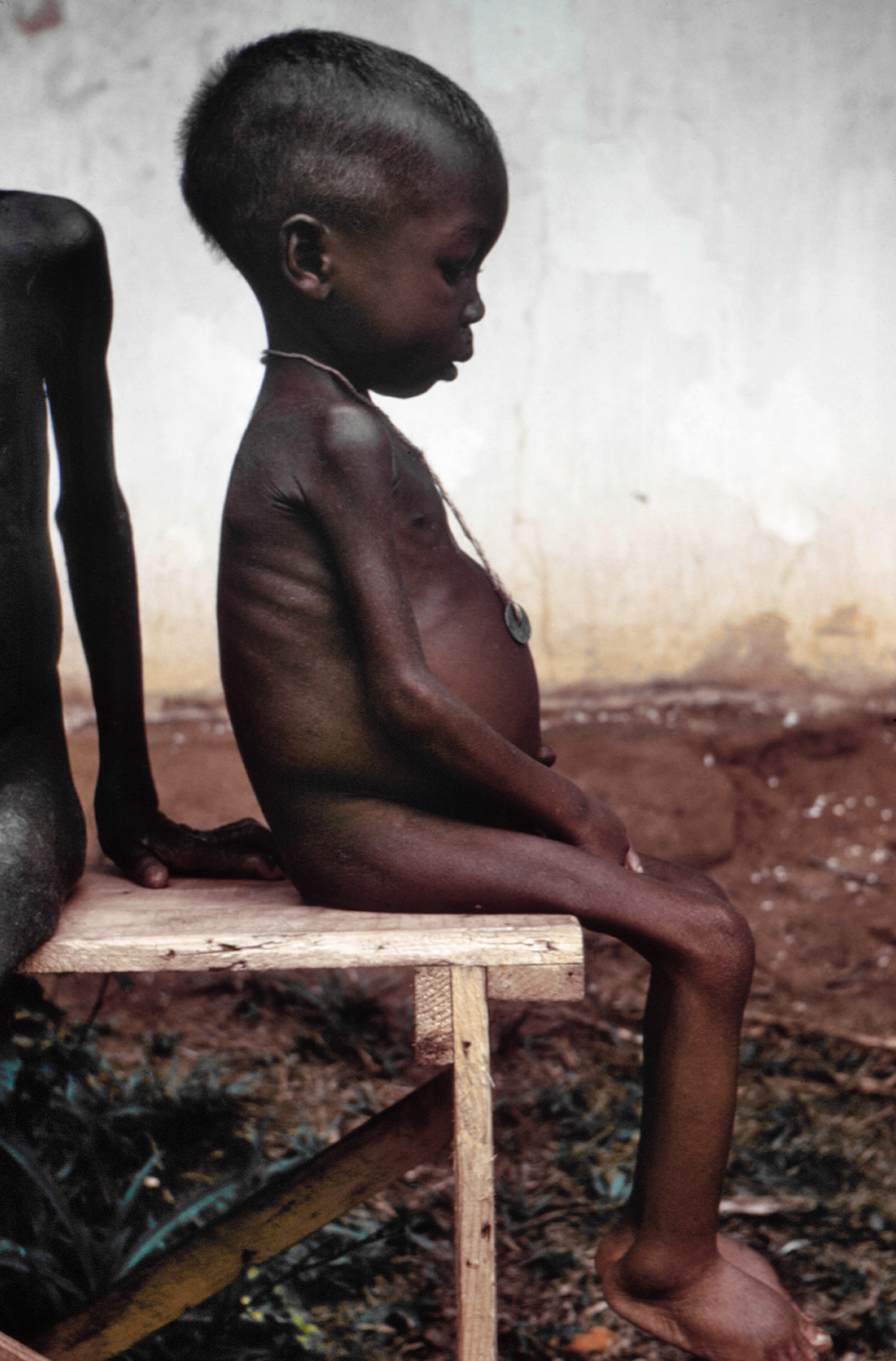
Although poverty is generally considered to be undesirable due to the pain and suffering it may cause, in certain spiritual contexts "voluntary poverty," involving the renunciation of material goods, is seen by some as virtuous.
Poverty may affect individuals or groups, and is not confined to the developing nations. Poverty in developed countries is manifest in a set of social problems including homelessness and the persistence of "ghetto" housing clusters.
Measuring poverty
Poverty can be measured in terms of absolute or relative poverty. Absolute poverty refers to a set standard which is consistent over time and between countries. An example of an absolute measurement would be the percentage of the population eating less food than is required to sustain the human body (approximately 2000-2500 calories per day for an adult male).
The World Bank defines extreme poverty as living on less than US$ (PPP) 1 per day, and moderate poverty as less than $2 a day, estimating that "in 2001, 1.1 billion people had consumption levels below $1 a day and 2.7 billion lived on less than $2 a day." The proportion of the developing world's population living in extreme economic poverty fell from 28 percent in 1990 to 21 percent in 2001. Looking at the period 1981-2001, the percentage of the world's population living on less than $1 per day has halved.
However, most of this improvement has occurred in East and South Asia In East Asia the World Bank reports that "The poverty headcount rate at the $2-a-day level is estimated to have fallen to about 27 percent, down from 29.5 percent in 2006 and 69 percent in 1990."
In Sub-Saharan Africa GDP/capita shrank by 14 percent and extreme poverty increased from 41 percent in 1981 to 46 percent in 2001, increasing the number of people living in poverty from 231 million to 318 million.
Other regions have seen little change. In the early 1990s the transition economies of Eastern Europe and Central Asia experienced a sharp drop in income. Poverty rates rose to 6 percent at the end of the decade before beginning to recede.
World Bank data shows that the percentage of the population living in households with consumption or income per person below the poverty line has decreased in each region of the world since 1990:
| Region | 1990 | 2002 | 2004 |
|---|---|---|---|
| East Asia and Pacific | 15.40% | 12.33% | 9.07% |
| Europe and Central Asia | 3.60% | 1.28% | 0.95% |
| Latin America and the Caribbean | 9.62% | 9.08% | 8.64% |
| Middle East and North Africa | 2.08% | 1.69% | 1.47% |
| South Asia | 35.04% | 33.44% | 30.84% |
| Sub-Saharan Africa | 46.07% | 42.63% | 41.09% |
There are various criticisms of these measurements. Shaohua Chen and Martin Ravallion note that although "a clear trend decline in the percentage of people who are absolutely poor is evident, although with uneven progress across regions...the developing world outside China and India has seen little or no sustained progress in reducing the number of poor". However, since the world's population has increased, if instead looking at the percentage living on less than $1/day, and if excluding China and India, then this percentage has decreased from 31.35% to 20.70% between 1981 and 2004.
Other human development indicators are also improving. Life expectancy has greatly increased in the developing world since WWII and is starting to close the gap to the developed world where the improvement has been smaller. Even in Sub-Saharan Africa, where most Least Developed Countries are to be found, life expectancy increased from 30 years before World War II to a peak of about 50 years, before the HIV pandemic and other diseases started to force it down to the current level of 47 years. Child mortality has decreased in every developing region of the world. The proportion of the world's population living in countries where per-capita food supplies are less than 2,200 calories (9,200 kilojoules) per day decreased from 56% in the mid-1960s to below 10% by the 1990s. Between 1950 and 1999, global literacy increased from 52% to 81% of the world. Women made up much of the gap: Female literacy as a percentage of male literacy has increased from 59% in 1970 to 80% in 2000. The percentage of children not in the labor force has also risen to over 90% in 2000 from 76% in 1960. There are similar trends for electric power, cars, radios, and telephones per capita, as well as the proportion of the population with access to clean water. The book The Improving State of the World finds that many other indicators have also improved.
Relative poverty views poverty as socially defined and dependent on social context. Income inequality is a relative measure of poverty. A relative measurement would be to compare the total wealth of the poorest one-third of the population with the total wealth of richest 1% of the population. There are several different income inequality metrics. One example is the Gini coefficient.
Income inequality for the world as a whole is diminishing. A 2002 study by Xavier Sala-i-Martin finds that this is driven mainly, but not fully, by the extraordinary growth rate of the incomes of the 1.2 billion Chinese citizens. However, unless Africa achieves economic growth, then China, India, the OECD and the rest of middle-income and rich countries will increase their relative advantage, and global inequality will rise.
The 2007 World Bank report "Global Economic Prospects" predicts that in 2030 the number living on less than the equivalent of $1 a day will fall by half, to about 550 million. An average resident of what we used to call the Third World will live about as well as do residents of the Czech or Slovak republics today. However, much of Africa will have difficulty keeping pace with the rest of the developing world and even if conditions there improve in absolute terms, the report warns, Africa in 2030 will be home to a larger proportion of the world's poorest people than it is today. However, economic growth has increased rapidly in Africa after the year 2000.
In many developed countries the official definition of poverty used for statistical purposes is based on relative income. As such many critics argue that poverty statistics measure inequality rather than material deprivation or hardship. For instance, according to the U.S. Census Bureau, 46% of those in "poverty" in the U.S. own their own home (with the average poor person's home having three bedrooms, with one and a half baths, and a garage). Furthermore, the measurements are usually based on a person's yearly income and frequently take no account of total wealth. The main poverty line used in the OECD and the European Union is based on "economic distance", a level of income set at 50% of the median household income. The US poverty line is more arbitrary. It was created in 1963-64 and was based on the dollar costs of the United States Department of Agriculture's "economy food plan" multiplied by a factor of three. The multiplier was based on research showing that food costs then accounted for about one third of the total money income. This one-time calculation has since been annually updated for inflation. Others, such as economist Ellen Frank, argue that the poverty measure is too low as families spend much less of their total budget on food than they did when the measure was established. Further, federal poverty statistics do not account for the widely varying regional differences in non-food costs such as housing, transport, and utilities.


 Posts
Posts


2 comments:
U R Postes Are Great Murali
Issues like poverty are one of the primary concerns of the nation.
The year 2010 presents a crucial moment to assess the ground covered over the last decade and the distance that remains to be traversed over the next five years. In fact, that is just what the United Nations General Assembly will do when it meets this September. How well is India placed to catch the MDGs bus? The Government of India has just done its own assessment http://bit.ly/9XYkyQ
Post a Comment